
Key Takeaways
- A professional office furniture manufacturing process involves multiple stages, from material preparation to final inspection.
- Precision cutting, edge sealing, drilling, and assembly all affect the quality of finished furniture.
- Quality control should be integrated throughout production, rather than performed only at the end.
- Proper inspection and packaging help reduce problems during transportation and installation.
- For B2B projects, a controlled production process helps improve consistency, reliability, and delivery performance.
Introduction: What Happens Before Office Furniture Reaches Your Project?
A finished office desk or workstation may look simple, but there is a structured manufacturing process behind every completed product.
For B2B buyers, especially those sourcing furniture for offices, commercial buildings, hotels, and large workplace projects, understanding the office furniture manufacturing process can provide valuable insight into a supplier’s production capabilities and quality management.
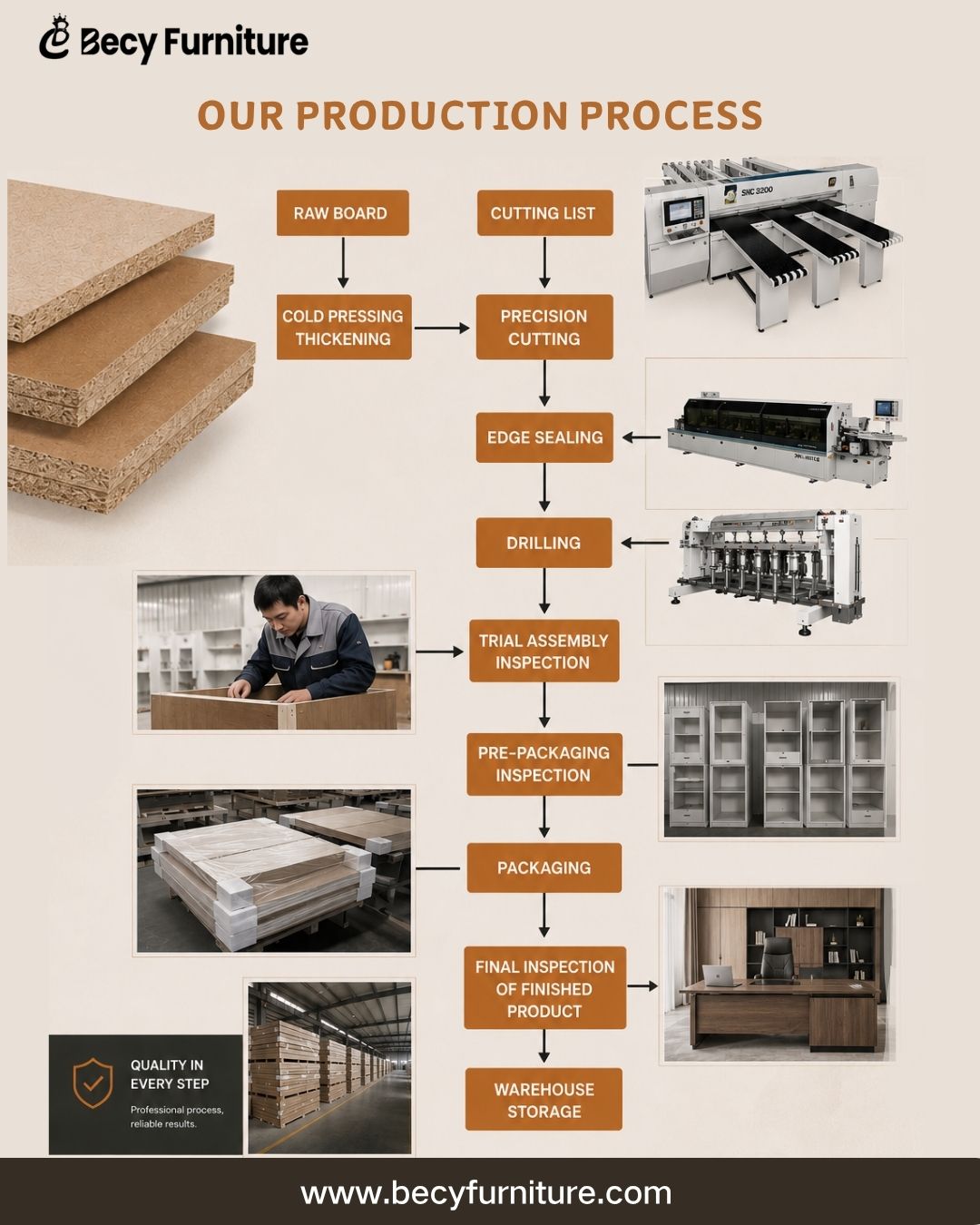
From raw boards and precision cutting to drilling, assembly, inspection, and packaging, every stage contributes to the final result.
At Becy Furniture, we believe reliable furniture starts with a reliable production process.
1. Material Preparation: Building the Foundation
The first stage of the office furniture production process is material preparation.
Depending on the product design and project requirements, different types of engineered wood panels and other materials may be selected for office desks, workstations, conference tables, and storage units.
For project furniture, material consistency is especially important. Large orders may contain dozens or hundreds of products, and every unit needs to maintain a consistent appearance, structure, and specification.
Before production begins, materials are prepared according to the approved product specifications and production requirements. This creates a reliable foundation for the following manufacturing stages.
2. Precision Cutting and Edge Sealing
After material preparation, boards are processed according to approved drawings and cutting lists.
Precision cutting is an important part of custom office furniture manufacturing because the dimensions of each component directly affect the final assembly.
For desks, workstations, cabinets, and conference tables, even relatively small dimensional differences can create problems when multiple components need to fit together.
After cutting, exposed panel edges are processed through edge sealing. This improves the appearance of the furniture while also helping protect the panel edges during everyday use.
For large B2B orders, consistent cutting and edge finishing are particularly important because differences become more visible when many units are installed together.
3. Precision Drilling and Component Assembly
The next stage is drilling and component preparation.
Different furniture components require precisely positioned holes for connectors, screws, hinges, drawer systems, and other hardware. Accurate drilling helps ensure that components can be assembled according to the approved design.
This is particularly important for customized office furniture, where different projects may have different dimensions, configurations, and hardware requirements.
After machining, components can proceed to trial assembly. This stage provides an opportunity to confirm that parts fit correctly and that the overall structure matches the intended design.
Why Trial Assembly Matters for Project Furniture
For B2B furniture projects, identifying a problem before shipment is much easier than correcting it after the furniture reaches the project site.
Trial assembly can help reveal issues such as dimensional deviations, incorrect hole positions, unsuitable hardware, or component mismatches.
This step is particularly valuable for customized furniture because the products may need to fit specific layouts or installation conditions.
A controlled assembly process therefore helps reduce unnecessary rework and supports smoother project installation.
4. Quality Inspection Before Packaging
Quality control is an essential part of the office furniture manufacturing process.
Before packaging, furniture should be checked against the approved specifications. Depending on the product and project requirements, inspection may include appearance, dimensions, component matching, hardware, assembly condition, and quantity.
For project orders, this inspection also helps ensure that the products correspond with the production list.
A systematic inspection process can identify potential problems before furniture leaves production, reducing the risk of missing components, incorrect quantities, or visible defects during installation.
Quality management is also an important principle in modern manufacturing. ISO describes ISO 9001 as a globally recognized quality management standard that focuses on establishing, maintaining, and continually improving quality management systems. ISO 9001 – Quality Management Systems
5. Packaging for Safe Project Delivery
Manufacturing quality is only one part of successful B2B furniture delivery. The finished products must also be properly protected during transportation.
Office furniture may travel through several stages before reaching the final project location, including factory handling, container loading, international transportation, unloading, and local delivery.
For this reason, packaging should take the product structure and transportation requirements into consideration.
Clear product identification and organized packaging can also help installation teams locate the correct components more efficiently.
For commercial furniture, industry standards can also provide useful references for evaluating product safety, durability, and performance. BIFMA develops and maintains standards for commercial furniture products and related performance requirements. BIFMA Standards
6. Final Inspection and Warehouse Storage
Before finished furniture enters warehouse storage or is prepared for shipment, a final inspection provides one more quality checkpoint.
The finished products can be reviewed for appearance, quantity, specifications, and overall condition.
This is especially important for large project orders involving multiple furniture types, sizes, finishes, and configurations.
After final inspection, products are organized in the warehouse according to the delivery plan. Proper warehouse organization helps ensure that the correct products can be prepared for shipment when required.
Why the Manufacturing Process Matters for B2B Buyers
For B2B buyers, choosing an office furniture supplier is not simply about comparing product images and prices.
A reliable supplier should be able to maintain product consistency, follow approved specifications, manage quality control, support customization, and coordinate production for project requirements.
This is particularly important for office furniture projects where many products need to be delivered within the same schedule.
A well-organized office furniture manufacturing process helps connect product design, production, inspection, packaging, and delivery into one controlled workflow.
For buyers, this means fewer surprises and greater confidence throughout the project.
Becy Furniture: Supporting Project-Based Office Furniture
At Becy Furniture, we provide office furniture solutions for commercial and project-based applications.
Our product range covers office desks, workstations, conference furniture, training furniture, seating, storage, and customized solutions.
For project clients, furniture can be developed according to specific dimensions, materials, layouts, and functional requirements.
Our office workstation solutions are designed for shared workplaces and flexible office layouts, with different configurations available for different space requirements.
For clients looking for evidence of project experience, our project case studies show examples of customized office furniture solutions delivered for projects in markets including Saudi Arabia and the UAE.
Conclusion: Quality Is Built Into Every Step
A finished office desk, workstation, conference table, or storage cabinet is the result of many connected processes.
From raw board preparation and precision cutting to drilling, assembly, inspection, packaging, and storage, every stage contributes to the final quality of the product.
For B2B buyers, understanding the office furniture manufacturing process can provide a clearer view of how a supplier manages quality and project requirements.
At Becy Furniture, we believe that reliable furniture begins with a reliable process — quality in every step, from raw board to finished product.
Planning an Office Furniture Project?
If you are sourcing furniture for an office, commercial development, hotel, or other project, Becy Furniture can support your requirements with customized office furniture solutions.
Share your drawings, BOQ, product references, or project requirements with our team to discuss a suitable furniture solution.